Standard Pedestrian Barriers
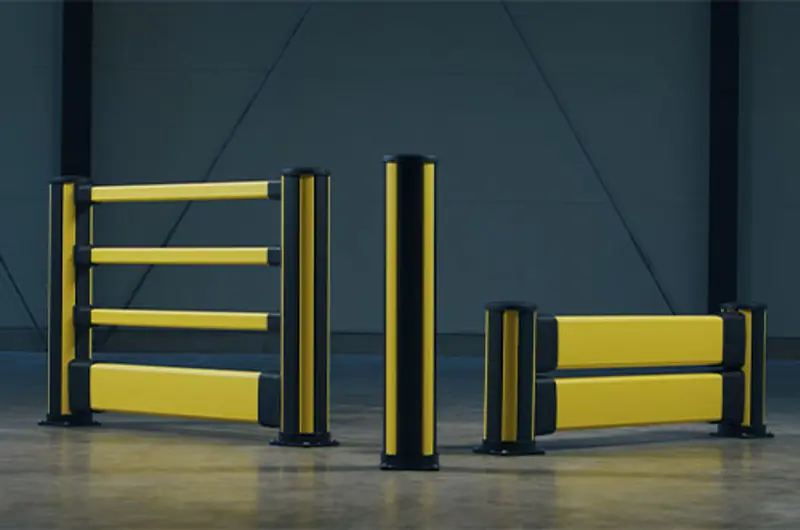
Basic pedestrian barriers use three horizontal rails at pedestrian height, typically reaching 45-46 inches tall. These function primarily as visual boundaries and light physical barriers, handling impacts in the 4,000-5,000 joule range—roughly a 5,500-pound forklift at 2.5 mph.
Standard barriers work well for defining walkways in organized facilities where equipment operates at controlled speeds. They mark routes from employee entrances to work areas or create boundaries around offices on the warehouse floor. The limitation: they won't stop aggressive forklift contact at operational speeds.
Pedestrian + Impact Barriers
Adding a dedicated impact rail at ground level changes the protective capability significantly. This configuration combines pedestrian handrails with impact absorption at the height where forklift tines and pallet loads make contact, typically within 12-15 inches off the floor.
Load capacity jumps to 6,000-7,000 joules, handling heavier equipment at higher speeds. Aisles with active forklift traffic benefit from this configuration, as do cross-aisle intersections where forklifts make tight turns. Loading areas where pallets frequently pass close to pedestrian zones need this level of protection.
Pedestrian + Impact High Barriers
Some facilities find their impact risk comes from higher contact points rather than ground level. The high configuration positions the impact rail at an elevated point on the posts, providing 8,000+ joules of protection where vehicle bodies contact barriers rather than forks.
The trade-off is reduced ground-level protection. Evaluate your actual incident history. If most scrapes and bumps happen at vehicle body height rather than fork height, this configuration makes sense. If you're unsure, standard impact height probably covers more scenarios.
Pedestrian + Double Impact Barriers
Maximum protection comes from two impact rails at different heights plus pedestrian handrails. This covers ground-level fork impacts and elevated vehicle body contact simultaneously, with load capacity reaching 8,000-8,300 joules.
Cross-docking zones where vehicles move at higher speeds justify this investment, as do loading bay entrances and high-traffic intersections. The cost difference compared to single impact configurations should be weighed against potential losses. One forklift breaching a barrier and striking inventory easily exceeds the price difference.
Pedestrian + Floor Barriers
A low-profile barrier at floor level, typically 6-8 inches high, closes the gap between concrete and the lowest horizontal rail. This prevents forklift tines angled downward from sliding under the barrier, stops pallet loads being dragged from breaching, and blocks small equipment like pallet jacks.
Food distribution and pharmaceutical facilities often use this configuration, where preventing any breach matters more than cost considerations.
Modular vs. Fixed Systems
Construction methodology affects long-term value significantly. Fixed systems use welded assemblies that can't be reconfigured without cutting and re-welding. Modular systems use slide-together connections. Damaged rails slide out, new ones slide in, and entire sections can be relocated as layouts change.
For facilities that rearrange occasionally (and most warehouses do eventually), modular construction protects your investment. The barrier system adapts instead of becoming obsolete.