A Guide to Pedestrian Guard Rail Specifications

Selecting pedestrian guardrails for industrial facilities requires understanding specifications that directly impact worker protection. Industrial pedestrian barriers must address powered industrial vehicles operating in tight spaces, automated equipment following programmed paths, and the need to reconfigure protection as warehouse operations evolve.

Material Specifications and Their Performance Implications

Steel vs. Polymer Construction

Traditional guardrails use galvanized steel construction with welded tube frames. These systems rely on rigidity to stop impacts, transferring force to the barrier, floor, vehicle, and cargo. Polymer-based guardrails incorporate energy-dissipating cores that compress and absorb kinetic energy rather than deflecting it elsewhere, protecting workers, floors, equipment, and products.

Material choice determines repair requirements. Damaged steel barriers typically need welding repairs, which can shut down your protection for a full day or longer. Polymer systems let you swap out damaged components directly, no welding torch required. 

Temperature extremes make material choices even more important. Verify that barrier materials maintain performance characteristics across the temperature ranges your facility experiences, whether cold storage environments or outdoor loading docks exposed to extreme heat.

Explore the different types of pedestrian guard rails

Coating and Finish Specifications

Surface treatment specifications determine visibility and longevity. Steel guardrails need adequate galvanization. Hot-dip processes outlast electroplating for corrosion resistance. Yellow and black powder coating makes barriers impossible to miss, catching forklift operators' attention before accidents happen. Polymer options build color into the material itself, so scratches and scrapes won't expose underlying material or fade the safety striping.

Dimensional Specifications for Pedestrian Guard Rails

Height Requirements

Height specifications for industrial pedestrian barriers typically range from 1,050mm to 1,160mm (41 to 46 inches) above the walking surface. This industry-standard range intercepts forklift bodies, pallet loads, and loads at pedestrian chest height while maintaining operator sight lines.

These specifications differ from OSHA requirements for fall protection systems. OSHA Standard 1910.29 mandates 42-inch guardrails (plus or minus 3 inches) specifically for fall protection on elevated surfaces like loading docks, platforms, and mezzanines. That regulation doesn't apply to pedestrian-vehicle separation barriers on warehouse floors.

OSHA doesn't specify a mandated height for pedestrian barriers separating foot traffic from forklifts. These systems function as traffic control devices, so height follows industry best practices, ANSI guidance, and facility-specific hazard assessments rather than prescriptive OSHA rules. The 41 to 46-inch range has become the accepted standard because it reliably provides impact protection without creating trip hazards. Installing barriers significantly shorter can be viewed as a recognized hazard under OSHA's General Duty Clause, even without a specific height regulation for this application.

Rail Length and Post Spacing

Center-to-center spacing between posts affects installation costs and system performance. Traditional specifications call for posts at 2-meter intervals, requiring more floor penetrations. Recent advances allow extended spacing. Some systems offer reliable performance with posts spaced 2.5 to 3 meters apart. Fewer posts mean fewer holes drilled into concrete floors, preserving floor integrity and reducing installation costs.

How Impact Testing Works for Industrial Guard Rails

Testing should mirror what actually happens in your warehouse. The most useful tests run weighted forklift replicas into barriers at documented speeds, recording the kinetic energy in joules. Look for test reports that spell out the vehicle weight, how fast it was traveling, the impact angle, and where it hit the barrier. A specification stating "tested to 4,500J" provides limited value without understanding whether that represents a 2,500kg forklift at 6.4 km/h or a 5,000kg vehicle at 4.5 km/h.

Installation Specifications That Affect Long-Term Performance

Anchoring and Foundation Specifications

Floor anchoring specifications determine installation costs and long-term reliability. Most industrial guardrails use expansion bolt anchoring with specifications for bolt diameters (12mm to 16mm), embedment depths (100mm to 150mm), and minimum concrete strength ratings. A guardrail designed for C30/37 grade concrete may not perform safely in older, lower-grade concrete.

Assembly Method Specifications

How components connect determines both your initial installation and any future changes. Welded barriers deliver solid strength, but you can't move them. Bolted systems come apart, though you'll need wrenches and torque specs. Slide-fit designs lock together through mechanical channels with no fasteners or tools, making reconfigurations straightforward when you rearrange the warehouse.

Modular Design Specifications

Modularity specifications determine component interchangeability. A truly modular system allows mixing posts and rails in various configurations, switching between pedestrian barriers, impact barriers, and other protection types using the same base components. Interface specifications should document connection points between different barrier types, affecting your ability to upgrade protection levels in specific zones.

Compliance Specifications for Industrial Environments

ANSI Standards for Industrial Safety Barriers

ANSI provides specifications for industrial workplace safety applications. ANSI MH31.2, for example, establishes test methodology for crash testing industrial guardrail barriers and barrier posts, covering steel and polymer bollards, industrial facility protection guardrail, and industrial pedestrian guardrail mounted on ground-level concrete. ANSI MH31.2 provides standardized testing methodology, but facilities should verify that barrier specifications align with multiple relevant standards and recognized industry practices for their specific applications.

Industry-Specific Specification Requirements

Food processing and pharmaceutical facilities may require specifications for materials approved for use in sanitary environments, including smooth surfaces without crevices and materials that are compatible with regular washdown procedures. Cold storage operations require specifications to be verified for low-temperature performance, as some materials that perform well at room temperature become brittle in freezer environments.

Evaluating Specifications for Your Facility

Matching Specifications to Operational Hazards

Selecting appropriate specifications requires analyzing your specific operating conditions:

  1. Document your vehicle specifications: List forklift models with their loaded weights, maximum speeds, and typical operating areas. Include automated vehicles with their programmed speeds and pathways.
  2. Map impact risk levels by area: High-speed cross-docking zones require higher load capacity specifications. Tight-turn picking aisles where slower speeds prevail might justify lower specifications with better visibility features.
  3. Project your flexibility requirements: Facilities planning automation additions need barrier specifications that accommodate future reconfigurations. Operations with seasonal layout changes benefit from specifications that allow easy disassembly and reinstallation.

Match the testing specifications to your findings. If your largest forklift weighs 11,000 pounds and operates at 5 mph in certain zones, look for barrier specifications tested at or above those parameters.

Axelent X-Protect Pedestrian Barrier Specifications

Standard Configuration Specifications

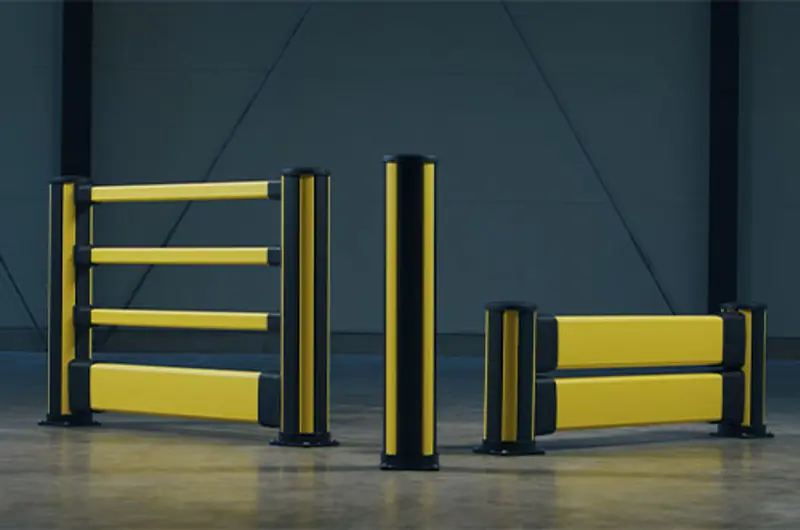
Our X-Protect Pedestrian Barriers stand 1,160mm (45.7 inches) tall and handle 4,000J to 5,000J loads, depending on how you space the posts. Rails come in lengths from 270mm to 1,770mm (10.6 to 69.7 inches), giving you options for different aisle widths and corner turns.

Enhanced Protection Configurations

Some zones see heavier traffic. The Pedestrian + Impact version bumps capacity to 6,700J for medium-duty protection. Pedestrian + Impact High handles 8,000J in areas where impact risk runs higher.

The Pedestrian + Double Impact specification provides 8,300J load capacity, appropriate for protecting walkways near loading zones or high-traffic cross-docking areas. The Pedestrian + Floor Barrier configuration adds low-level protection, preventing vehicle forks and pallet loads from sliding beneath standard rails.

Material and Construction Specifications

X-Protect uses polymer construction with energy-dissipating cores throughout the system. The material maintains performance from -10°C to 40°C (14°F to 104°F), suitable for both cold storage and outdoor loading environments. Color is molded through the material—yellow (RAL 1018) and black (RAL 9011)—maintaining high visibility throughout the product service life.

Installation and Modification Specifications

Installation specifications require only basic tools: a hammer drill for anchor holes and a hex key for set screws. The slide-fit connection specification allows rails to engage posts without the need for fasteners. This specification enables modification without specialized labor or equipment. The modular specification allows disassembly and reassembly without degradation, so barriers relocated during facility reconfigurations perform identically to the original installation.

About Axelent

Selecting pedestrian guard rail specifications that match your facility's hazards, equipment, and future flexibility needs requires balancing immediate protection with long-term operational costs. 

Axelent manufactures X-Protect impact protection systems from our headquarters in Hillerstorp, Sweden, where all product development and testing occurs. Our polymer-based, modular pedestrian barrier systems feature energy-dissipating construction, component-level repairability, extended post spacing that reduces floor penetrations, and configurations tested across load capacities from 4,000J to 8,300J. X-Protect systems operate across warehouse environments from cold storage to outdoor loading docks, with slide-fit assembly enabling reconfiguration as facility layouts evolve.

Contact us today to review pedestrian guard rail specifications matched to your facility's equipment, operational zones, and protection requirements.

FAQ

Related articles

Find more resources and Knowledge

Pedestrian Guard Rail Types & Standards

In warehouses and manufacturing plants, forklifts and workers share the same floor space. Pallet...

Warehouse Automation: A Comprehensive Guide to What It Is & How It Works

How do modern warehouses keep pace with surging order volumes and increasingly tight delivery dea...

We are making safety more accessible

Our knowledge about safety solutions is now more accessible than ever.

How to Reduce Lead Time in Warehouses With Automation

Warehouse lead times directly impact customer satisfaction, operational costs, and bottom-line pr...

Let´s Talk Safety cover

Safety standards are complex – but understanding them doesn’t have to be.

Our new podcast breaks down key topics into short, accessible episodes based on real safety challenges. Whether you're commuting, working hands-on or just want to stay up to date – this is safety knowledge that fits your day.